
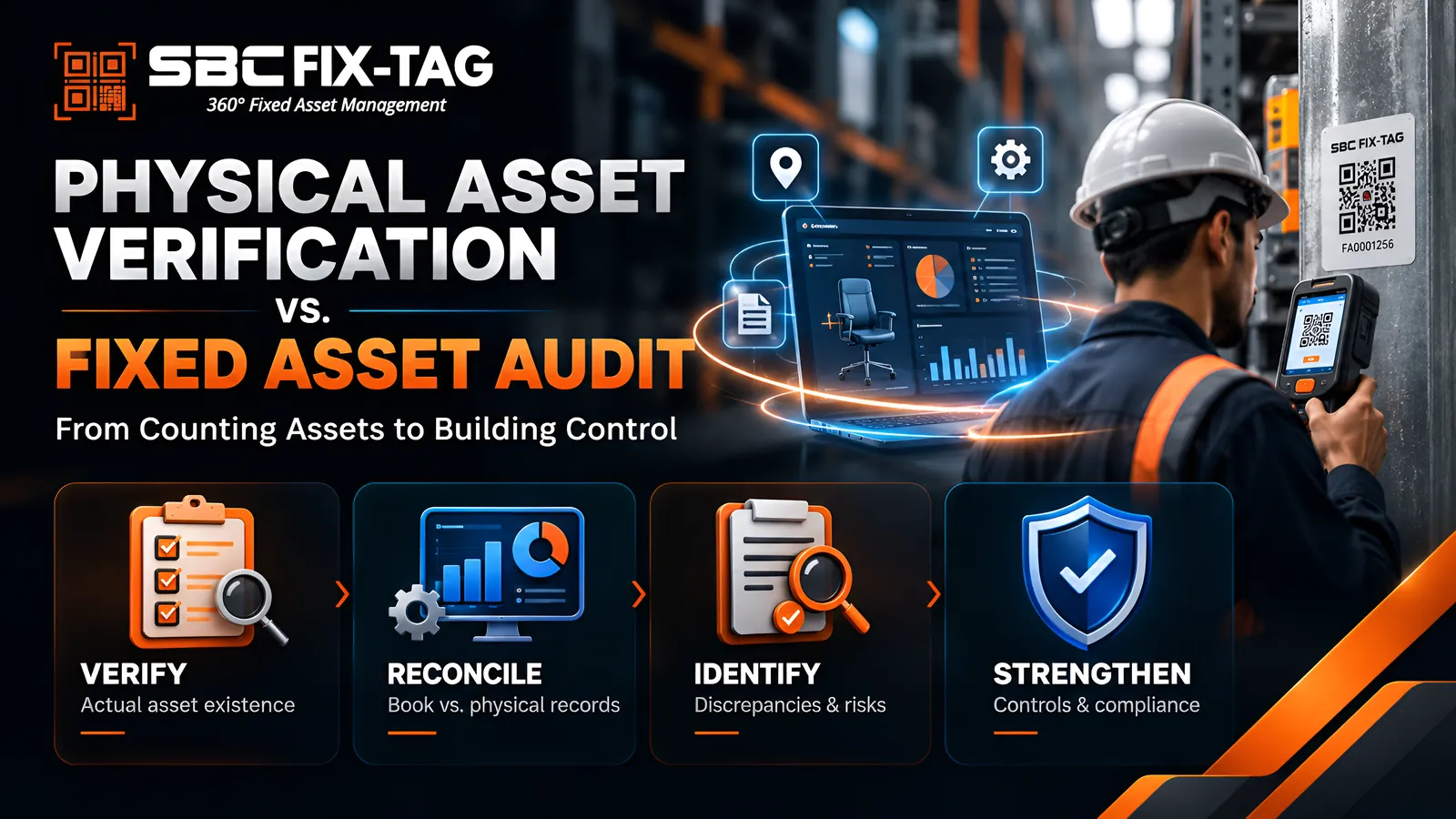
Businesses invest in computers, furniture, machinery, vehicles, office equipment and other long-term assets. To keep these assets accounted for and under control, organisations need reliable records and regular checks. Two important processes are physical asset verification and a fixed asset audit. Although closely related, they serve different purposes.
Physical asset verification focuses on confirming that recorded assets actually exist, where they are located and what condition they are in. A fixed asset audit is broader. It examines asset records and related controls, supporting documents, accounting treatment, depreciation, additions, disposals and reconciliation with the books of accounts.
Understanding the difference helps finance teams, asset managers and business owners improve fixed asset management, strengthen internal controls and prepare more reliable records for financial reporting and audit review.
What is physical asset verification?
Physical asset verification is the process of checking an organisation's physical assets against its Fixed Asset Register (FAR) or other asset records. The purpose is to establish whether assets are present, correctly identified, located where records indicate and in an appropriate condition.
A verification team may inspect laptops, desktops, printers, furniture, plant and machinery, tools, vehicles and other tangible assets. The team records details such as the asset identification number, description, location, custodian, condition and any mismatch found.
What does physical asset verification check?
- Whether the asset physically exists and can be identified.
- Whether its asset tag, QR code, barcode or identification number matches the register.
- Whether the recorded location, department and assigned custodian are correct.
- Whether the asset is in use, idle, damaged, obsolete, missing or awaiting disposal.
- Whether physical details match the asset register and supporting records.
- Whether discrepancies are documented, investigated and assigned for corrective action.
A structured physical asset verification process can use QR code or barcode scanning to capture asset information, reduce manual data entry and create a traceable verification record. The method should suit asset volume, asset type, site access and control requirements.
What is a fixed asset audit?
A fixed asset audit is a systematic review of an organisation's fixed asset records, supporting documents, accounting treatment and related controls. Depending on its purpose and scope, it may include physical verification, but it also examines whether asset transactions have been recorded and reported appropriately.
A fixed asset audit may be part of an internal audit, statutory audit procedures, a financial reporting review or a management control exercise. The precise procedures depend on the engagement, applicable accounting framework, company circumstances and the auditor's responsibilities.
What does a fixed asset audit check?
- Completeness and accuracy of the Fixed Asset Register and fixed asset schedule.
- Purchase invoices, purchase orders, delivery records, installation evidence and approvals for additions.
- Classification of assets and whether expenditure has been correctly capitalised or expensed.
- Depreciation methods, useful lives, rates and calculations under the applicable accounting framework.
- Asset disposals, write-offs, transfers, impairments and supporting approvals.
- Reconciliation of the Fixed Asset Register with the general ledger and financial statements.
- Physical verification reports, asset identification controls and resolution of discrepancies.
- Ownership or title documents and other evidence where relevant to the asset type.
In India, requirements may depend on the company's reporting framework and circumstances. Relevant references can include AS 10, Ind AS 16 and applicable company audit reporting requirements, such as CARO 2020 clause 3(i). Confirm which standards and legal requirements apply to the specific entity.
Physical asset verification vs. fixed asset audit: key differences
| Comparison point | Physical asset verification | Fixed asset audit |
|---|---|---|
| Main objective | Confirm physical existence, identity, location and condition. | Assess asset records, transactions, accounting and relevant controls. |
| Scope | Primarily physical assets and matching details to the register. | Broader review of records, documents, accounting treatment and controls; may include physical verification. |
| Typical activities | Inspect or scan assets; confirm location and custodian; record mismatches. | Review invoices, approvals, asset classification, depreciation, disposals, reconciliations and verification evidence. |
| Primary evidence | Observation, asset tags, scan records, location data and verification sheets. | Ledgers, register, invoices, approvals, calculations, reconciliation schedules and verification reports. |
| Main output | Physical verification report and discrepancy list. | Audit observations, findings, supporting evidence and conclusions within the agreed scope. |
| Who may perform it | Asset management team, finance team or designated verification provider. | Internal audit team, external auditor or other qualified reviewer, depending on purpose. |
| Frequency | Set according to policy, risk, asset types and applicable requirements. | Determined by audit plan, engagement scope, risk and applicable requirements. |
| Business value | Improves asset visibility and helps identify missing, misplaced or incorrectly recorded assets. | Supports reliable accounting, financial reporting, control assessment and audit readiness. |
Is physical asset verification the same as a fixed asset audit?
No. Physical asset verification is not the same as a fixed asset audit. Physical verification mainly checks assets on the ground and matches their details to records. A fixed asset audit typically covers a wider range of evidence, including record accuracy and completeness, asset additions and disposals, depreciation, accounting classification and internal controls.
Physical verification can form one part of a fixed asset audit. Finding an asset at a location does not by itself prove that its recorded cost, ownership, depreciation or accounting classification is correct. Similarly, a complete register does not prove that every recorded asset still exists.
Why businesses need both processes
1. Better Fixed Asset Register accuracy
Matching actual assets with the Fixed Asset Register can highlight missing records, incorrect locations, duplicate entries, unrecorded transfers and assets disposed of but still listed.
2. Stronger financial reporting
Reviewing supporting documents, depreciation and accounting entries helps finance teams identify inconsistencies that a physical count alone may not reveal.
3. Improved asset tracking and accountability
Asset tags, clear location data and custodian records help organisations track assets across departments, branches, warehouses and office locations.
4. Better audit readiness
Maintained registers, verification records, reconciliations and documented corrective actions make it easier to provide evidence during an internal or external audit.
5. More informed asset decisions
Reliable asset data helps management identify underused equipment, assets requiring maintenance and items that may need transfer, repair or disposal.
How to conduct physical asset verification effectively
Step 1: Prepare the asset list
Start with the latest Fixed Asset Register and organise the list by asset category, site, department and custodian.
Step 2: Define the verification scope
Confirm locations, asset categories, responsibilities, timelines and the method for recording exceptions.
Step 3: Identify each asset
Use existing asset IDs or apply appropriate tags. QR codes and barcodes can help capture unique asset details consistently.
Step 4: Inspect and record
Confirm existence, location, custodian and condition. Record assets that are missing, moved, damaged, idle or not listed.
Step 5: Reconcile the results
Compare verified asset data with the register and, where relevant, the general ledger and supporting documents.
Step 6: Investigate discrepancies
Assign each mismatch to a responsible person, establish the reason and document the action taken.
Step 7: Update records and retain evidence
Approve valid changes, update the register and retain dated verification reports and reconciliation evidence.
Common fixed asset audit and verification issues
- Assets physically present but missing from the Fixed Asset Register.
- Assets recorded in the register but not located during verification.
- Incorrect asset locations or outdated custodian details.
- Duplicate asset records or missing identification tags.
- Disposed, scrapped or transferred assets not updated in the register.
- Depreciation errors or incorrect asset classification.
- Capital expenditure recorded as repairs, or routine expenses incorrectly capitalised.
- Unresolved differences between the Fixed Asset Register and general ledger.
- Incomplete purchase documents, approvals or verification reports.
A discrepancy should not automatically be treated as fraud or a confirmed accounting error. Each exception needs to be investigated, supported by evidence and resolved under the organisation's approval and accounting procedures.
How fixed asset management software can help
For organisations managing assets across multiple locations, fixed asset management software can support a more consistent process. Depending on the solution and configuration, it can help maintain asset records, capture identification details, support QR code or barcode scanning, record location and custodian changes, document verification results and track discrepancies.
Digital asset tagging and a centralised Fixed Asset Register can reduce dependence on scattered spreadsheets and improve traceability. Software does not replace accounting judgement, evidence review or an auditor's independent responsibilities, but it can make asset data easier to maintain and verify.
SBC FIX-TAG provides fixed asset tagging and identification and physical asset verification services alongside its software.
Which process should your business choose?
If your main concern is whether recorded assets exist and are at the right locations, begin with physical asset verification. If you need to review asset records, supporting documents, depreciation, accounting treatment and related controls, a fixed asset audit may be required. Many organisations benefit from connecting the two processes so physical findings are reconciled with financial records.
The right scope depends on your asset base, risk profile, internal policy and applicable reporting requirements. Agree on the objectives, deliverables, responsibilities and treatment of discrepancies before starting.
Frequently asked questions
What is the difference between physical asset verification and a fixed asset audit?
Physical asset verification confirms that assets exist and checks their identity, location and condition against asset records. A fixed asset audit is broader and may review asset records, supporting documents, depreciation, additions, disposals, accounting treatment and controls.
Is physical verification part of a fixed asset audit?
It can be. Physical verification may provide evidence for a fixed asset audit, but the audit can also include document checks, ledger reconciliation, depreciation review and examination of asset transactions.
Why is a Fixed Asset Register important for an audit?
A Fixed Asset Register provides details such as asset identification, description, location, acquisition cost, date of purchase, depreciation and disposal information. Accurate records help support reconciliation, audit testing and financial reporting.
How often should fixed assets be physically verified?
Frequency should be set based on applicable requirements, company policy, asset value, risk, quantity, location and the practical difficulty of verification. Organisations should check the requirements that apply to their circumstances.
What documents are required for a fixed asset audit?
Depending on scope, documents may include the Fixed Asset Register, general ledger, purchase invoices, purchase orders, approvals, delivery or installation records, depreciation schedules, disposal documents, ownership records and physical verification reports.
Can QR codes improve physical asset verification?
QR codes can help identify assets quickly and link each tagged item to its asset record. They can improve data capture and traceability when tags are readable, records are maintained and procedures are properly designed.
What happens when an asset is missing during verification?
Record the exception, confirm the asset details and last known location, contact the responsible custodian, review transfer or disposal records, investigate the cause and document the approved resolution. Accounting entries should follow appropriate review.
Does a physical asset verification report replace an audit report?
No. A physical verification report documents the outcome of the verification exercise. It does not automatically replace an audit report or the independent procedures required for a particular audit engagement.
Conclusion
Physical asset verification and a fixed asset audit serve different but complementary purposes. Verification establishes what assets are physically present and where they are located. A fixed asset audit examines a broader set of records, transactions, accounting treatment and controls. When organisations reconcile physical findings with the Fixed Asset Register and financial records, they can improve asset visibility, strengthen controls and support audit readiness.
For businesses seeking better fixed asset tracking, asset tagging and physical asset verification, a well-maintained asset register and a documented verification process provide a practical foundation.